
Football squares in five steps
Set up the grid
Draw a 10×10 grid, or make a board on JaxSquares. Put one team across the top and the other down the side.
Claim squares
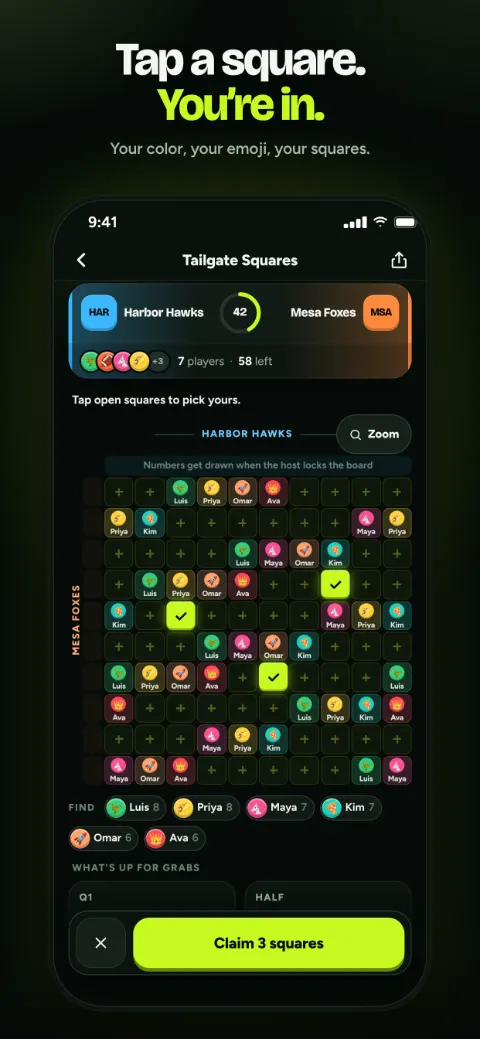
Players write their names in the squares they want, or tap them on a live board. A per-person limit keeps it fair.
Draw the numbers
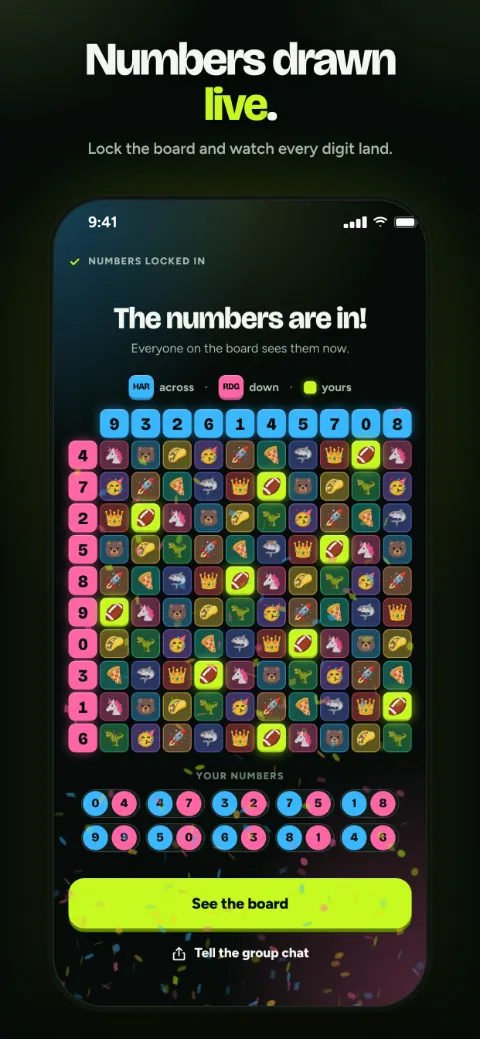
Once the board is full, assign the digits 0 to 9 at random across the top, then again down the side.
Check the score
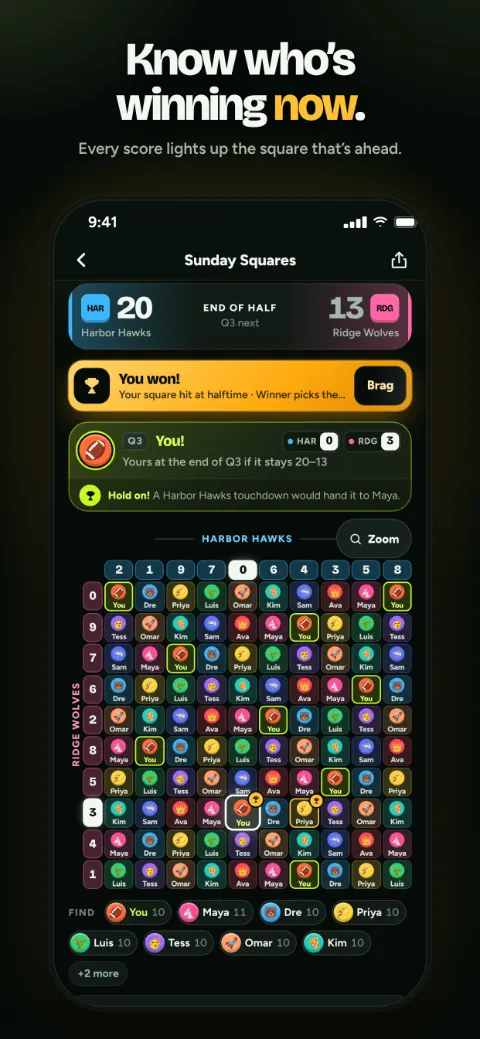
At the end of each quarter, at halftime and at the final, take the last digit of each team's score.
Find the winner
The square where those two digits meet wins. With reverse winners on, the square with the digits swapped wins too.
How the grid works
A football squares board is a grid with one team across the top and the other down the side. The classic board is 10 columns by 10 rows, which makes 100 squares.
Players claim squares before the game. On paper, they write their initials in the boxes; on JaxSquares they tap them, and each player's color and emoji show up in their squares. At this point the squares have no numbers yet, and that's the point: nobody can pick a good square, because nobody knows which square is which.
How the numbers get drawn
Once the board is full, or at a time everyone agreed on, the board locks and the numbers are drawn. The digits 0 to 9 are shuffled into a random order across the top, then shuffled again, separately, down the side. Every square now has two numbers: one for the team across the top and one for the team down the side.
On paper, the usual way is to pull ten numbered slips from a hat, once for each team. On JaxSquares the host taps Draw the numbers and the digits land on every phone at the same moment. Some groups like new numbers each quarter: the digits are reshuffled before every quarter, so a bad draw early doesn't sink your whole night.
Who wins
Winners are decided by the last digit of each team's score. If the score is Hawks 17, Wolves 14, the Hawks digit is 7 and the Wolves digit is 4, so the winning square is the one in the Hawks 7 column and the Wolves 4 row. A score of 20–10 points to the 0 and 0 square. Everything before the last digit is ignored.
When winners are decided depends on the format your group picks:
- Every quarter
- A winner at the end of the first quarter, at halftime, at the end of the third quarter and at the final score. Four winners: the classic setup.
- Halftime and final
- Two winners, one at halftime and one at the final score.
- Final score
- A single winner, decided by the score when the game ends. Overtime counts.
- Every score
- Each time the score changes, the square matching the new score wins, so a busy game can have a dozen winners. JaxSquares can even show a different prize for touchdowns, field goals, extra points, two-point conversions and safeties.
- Reverse
- The square with the two digits swapped wins too. At 17–14, both the 7–4 square and the 4–7 square win. If the digits match, like 7–7, that one square takes both. Reverse can be added to any format.
Quarter winners use the total score at the end of the quarter, not the points scored during it. A team with 10 at the end of the first quarter and 17 at halftime is a 0 for Q1 and a 7 for halftime.
Agree ahead of time on what happens if a winning square is empty. The usual choices are carrying that prize to the next period or giving it to the nearest claimed square. On JaxSquares, the host can also pick a winner by hand.
10×10 or 5×5?
The classic 10×10 board has 100 squares with one number per row and column. Each square matches exactly one score combination, so it suits a big group: a party, an office or a family reunion, with people often taking several squares each.
A 5×5 board has 25 squares with two numbers in each row and column. Each square covers four score combinations (two digits for each team), so a small group still covers every possible score and the board fills up fast. It's the one for four to ten people, a tailgate, or a weeknight game with a couple of friends.
| 10×10 | 5×5 | |
|---|---|---|
| Squares | 100 | 25 |
| Numbers per row and column | 1 | 2 |
| Score combinations per square | 1 | 4 |
| Best for | Parties, offices, big families | Small groups and tailgates |
Either way, set a square limit per person so everyone gets a fair shot at the board.
Square price and prizes, without JaxSquares touching the money
Squares works great just for fun, for bragging rights or for a prize like the last slice of pizza. Some groups like to play with a square price and prizes too. Here's how that works on JaxSquares:
- The host shows it, the app never touches it: when you make a board, you can show a square price and a prize for each period, in dollars or in points. It's display-only information that everyone sees before they pick.
- Players settle among themselves: JaxSquares never collects, holds or sends money between players, and it doesn't keep track of who owes what. Any settling up happens directly within your group, just as it would with a paper sheet.
- Just for fun is one tap: mark the board Just for fun and no amounts appear anywhere. Prize notes like “Loser brings the wings” or “Winner picks the halftime playlist” work on any board.
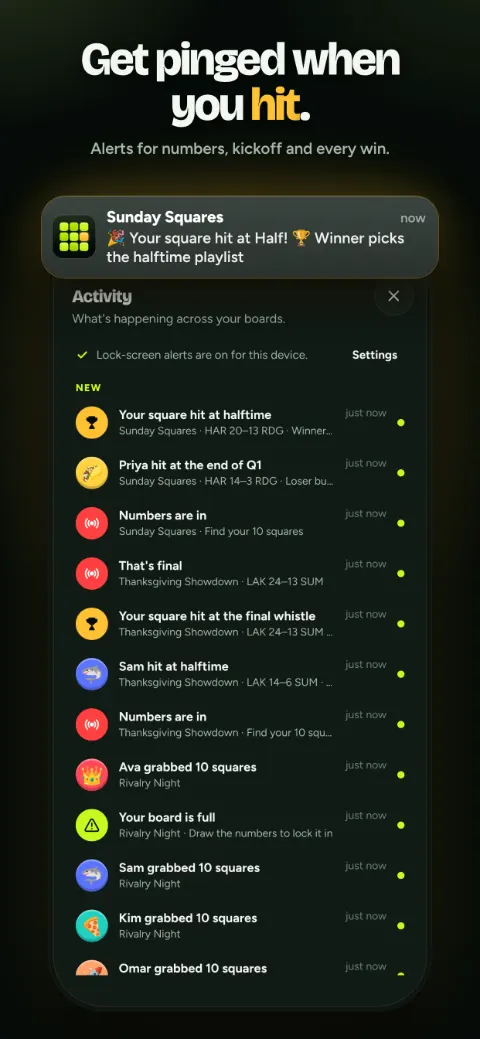
- Amounts stay on the board: they never appear in invite messages, link previews or notifications.
If your group plays with money involved, make sure that's allowed where you live and at your workplace. When in doubt, play for bragging rights.
Squares etiquette
- Share the rules before anyone picks: the format, the square limit, what happens with an empty winning square, and any prizes.
- Draw after the board is full, never before: that's what keeps it fair.
- No swapping after the draw: once the numbers are on the board, everyone keeps what they picked.
- Give everyone a fair shot: a square limit stops one early bird from taking half the board, and the last few open squares can go to whoever's still waiting.
- Settle up promptly and directly: if your group plays for prizes, sort it out among yourselves soon after the game, and be a gracious winner.
- Keep it friendly: it's a party game. Cheer for the score you need, and save some sympathy for whoever drew the 2 and the 5.
Ready to try it? Our guides for big game squares, NFL squares and college football squares have ideas for every kind of game day, and the printable templates are free.
Questions people ask
Do you need to know football to play squares?
No. Once the numbers are drawn, squares is pure luck. All you need to do is read the score.
What are the best numbers in football squares?
In football, 0, 7, 3 and 4 tend to come up most because of touchdowns, extra points and field goals, while 2 and 5 are rare. That's why the numbers are drawn at random after everyone picks: nobody chooses their digits.
How does reverse work?
With reverse winners on, the square with the two digits swapped also wins. At 21–14, both the 1–4 square and the 4–1 square win. If the two digits match, like 7–7, that one square takes both.
Does overtime count?
Overtime counts toward the final score. Quarter and halftime winners are set at the end of those periods.
What happens if nobody owns the winning square?
Agree on it before the game. Most groups carry that prize to the next period or give it to the nearest claimed square, and on JaxSquares the host can pick a winner by hand.
How many squares can each person take?
Whatever your group agrees on. On JaxSquares the host sets a per-player limit when making the board and can change it later.
Run your first board
JaxSquares draws the numbers, keeps the score and lights up every winner. Free to set up, and friends join from a link.
Free to set up and invite. Players never need an app or an account.